


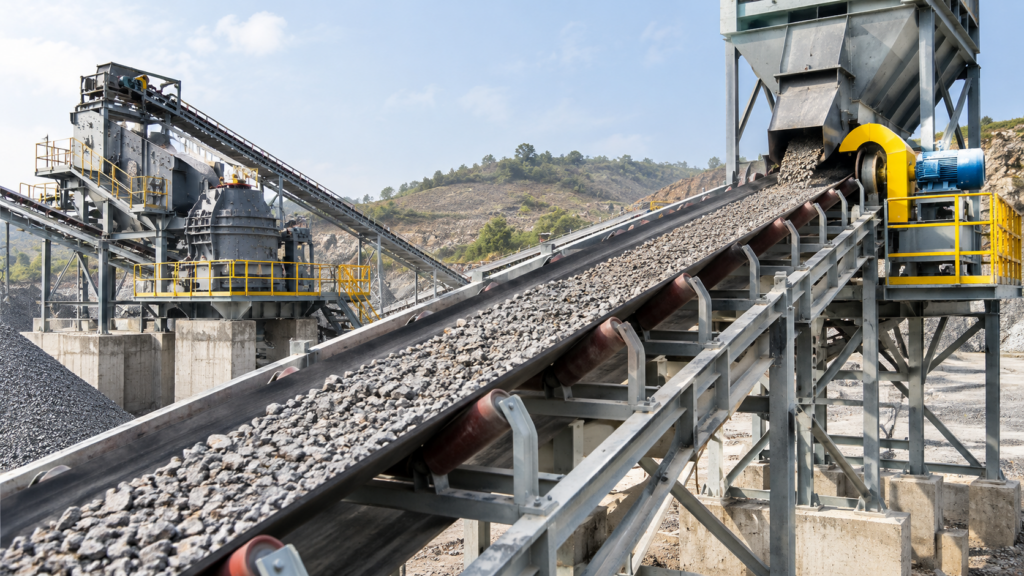
In a stone crusher plant or bulk material handling facility, conveyor belts operate continuously to move aggregates and other materials between processing stages. When a conveyor belt starts moving away from its intended path, the problem may initially appear minor. However, even a small tracking issue can gradually lead to material spillage, belt edge damage, excessive component wear and unexpected production downtime.
Conveyor belt misalignment, also known as conveyor belt mistracking, is one of the common operational challenges faced by quarry operators, crusher plants and industrial material handling facilities.
Understanding why belt misalignment occurs and how to prevent it can help plant owners improve equipment reliability, reduce maintenance costs and maintain consistent material flow.
In this guide, we explain the major causes, warning signs, troubleshooting methods and preventive maintenance practices associated with conveyor belt alignment.
What Is Conveyor Belt Misalignment?
Conveyor belt misalignment occurs when the belt moves sideways from its intended operating position instead of tracking correctly along the conveyor structure.
In a properly installed and maintained conveyor system, the belt should follow its designed path over pulleys and idler rollers while transporting material. When the belt shifts toward one side, it may contact structural components, cause uneven loading or interfere with the conveyor’s normal operation.
Misalignment may occur continuously or only under specific conditions, such as when the conveyor is loaded, after maintenance or during material transfer.
For industrial plants handling crushed stone, sand, gravel and other bulk materials, proper belt tracking is essential for maintaining reliable production.
Why Conveyor Belt Alignment Matters in Industrial Plants
Conveyor systems connect multiple stages of material processing. In a crusher plant, for example, conveyors may transport material from the primary crusher to screening equipment, secondary crushing stages and finished aggregate stockpiles.
If one important conveyor becomes unreliable, it can disrupt several connected operations.
Common consequences of conveyor belt misalignment include:
- Material spillage: Material can fall from the belt, creating cleanup requirements and reducing transfer efficiency.
- Premature belt wear: Continuous rubbing against the conveyor structure can damage belt edges.
- Roller and pulley damage: Uneven loading and abnormal contact can accelerate component deterioration.
- Unexpected downtime: Serious tracking problems may require the conveyor to be stopped for inspection or repair.
- Higher maintenance costs: Repeated adjustments, component replacement and cleanup increase operating expenses.
- Safety concerns: Damaged belts, spillage and exposed moving components can create hazards for personnel.
These challenges make conveyor alignment an important part of the overall efficiency of industrial conveyor systems.
7 Common Causes of Conveyor Belt Misalignment
1. Incorrect Idler Roller Alignment
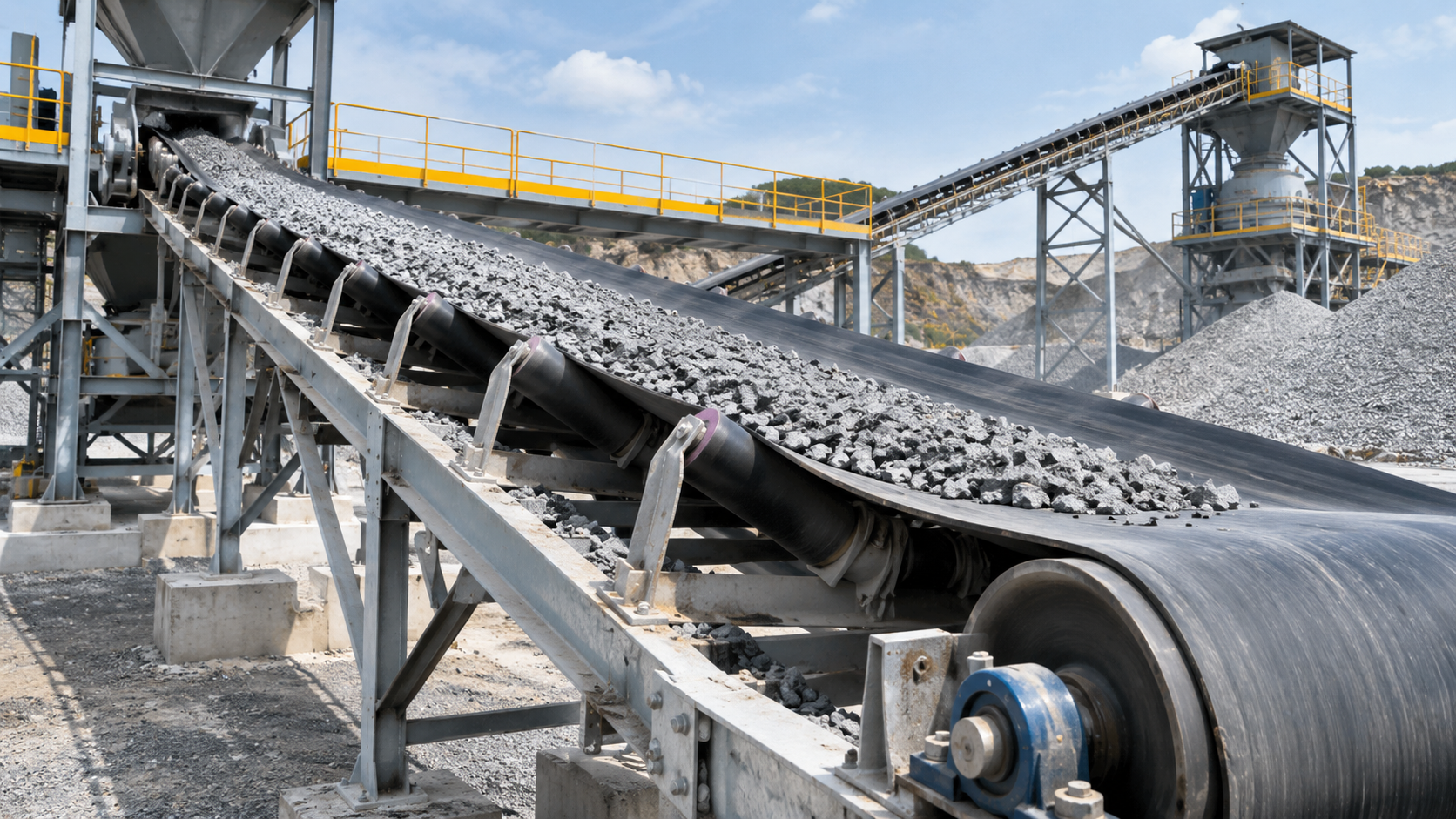
Idler rollers support and guide the conveyor belt as it moves along the structure.
If the idlers are installed incorrectly, become loose or shift away from their intended position, they can influence the direction of belt movement.
This problem may develop because of improper installation, structural vibration, damaged brackets or poor maintenance.
Recommended approach: Inspect the idler assemblies, mounting brackets and structural alignment. Correct the underlying installation or mechanical issue according to the conveyor manufacturer’s procedures.
2. Uneven Material Loading
Material should enter a conveyor at a suitable position and direction.
When aggregates or other bulk materials are consistently loaded toward one side, the resulting uneven load and associated forces can contribute to belt tracking problems.
This frequently occurs at transfer points where chutes are poorly positioned, obstructed or incorrectly designed.
Recommended approach: Check the feeding arrangement, transfer chute geometry and loading distribution. Aim for controlled, centrally directed material flow consistent with the conveyor’s design.
3. Material Buildup on Rollers and Pulleys
Dust, wet fines, clay and other materials can accumulate around conveyor components during continuous operation.
Material buildup may alter the effective contact surfaces of rollers and pulleys, creating uneven forces that affect belt tracking.
This issue can become more noticeable in plants processing wet or sticky aggregates.
Recommended approach: Inspect belt cleaners, return rollers, pulleys and transfer points. Remove accumulated material only after the conveyor has been safely isolated.
4. Incorrect Belt Tension
Proper conveyor belt tension is necessary to maintain suitable traction, belt support and stable operation.
Insufficient or uneven tension can contribute to operating problems, including belt slip and unstable tracking.
However, increasing belt tension without identifying the actual problem can create additional stress on bearings, pulleys and other mechanical components.
Recommended approach: Inspect the take-up system and verify belt tension against the equipment manufacturer’s recommendations. Avoid using excessive tension as a temporary correction.
5. Damaged or Improperly Installed Belt Splices
A conveyor belt splice joins the belt ends to form a continuous loop.
If the splice is not square, is damaged or has been installed incorrectly, it may contribute to repeated tracking deviations as the affected section travels around the conveyor.
Recommended approach: Inspect splice condition, belt geometry and signs of irregular wear. Use qualified personnel and approved joining procedures for repairs.
6. Worn or Seized Conveyor Rollers
Conveyor rollers must rotate correctly to support belt movement and material transport.
Seized bearings, damaged roller shells and excessive friction can create uneven resistance across the conveyor system.
Over time, these conditions may contribute to mistracking and additional belt damage.
Recommended approach: Include roller condition and bearing performance in routine inspections. Replace damaged components using the correct specifications.
7. Misaligned Conveyor Structure or Pulleys
Even a high-quality conveyor belt may not run correctly when the supporting structure is improperly aligned.
Distorted frames, incorrectly positioned pulleys and structural movement can affect the belt’s path.
For industrial installations, especially long conveyors, structural alignment should be assessed as part of a systematic troubleshooting process.
Recommended approach: Verify structural geometry and pulley alignment using appropriate measurement methods and manufacturer-approved tolerances. Do not make arbitrary pulley adjustments to compensate for other tracking problems.
How to Identify Conveyor Belt Tracking Problems
Early identification can help maintenance teams address problems before they lead to major equipment damage.
Plant operators should watch for the following signs:
- Belt movement toward one side of the conveyor.
- Repeated belt contact with nearby structural components.
- Uneven wear or visible damage along belt edges.
- Material spillage concentrated along one side.
- Abnormal sounds or vibration from rollers and pulleys.
- Tracking problems that appear only when material is loaded.
- Repeated activation of belt misalignment protection devices.
Maintenance teams should record where the problem occurs and whether it changes with load, operating conditions or belt position. This information can help identify the root cause.
Practical Conveyor Belt Maintenance and Inspection
Effective maintenance requires more than repeatedly adjusting rollers whenever the belt starts drifting.
The priority should be identifying and correcting the actual mechanical, structural or material-handling problem.
Daily Operational Checks
- Observe belt tracking from designated safe inspection locations.
- Check for unusual material spillage.
- Identify abnormal vibration, noise or visible component damage.
- Monitor loading consistency at transfer points.
- Report damaged guards, exposed moving parts or abnormal operating conditions.
Scheduled Preventive Maintenance
- Inspect idlers, pulleys and mounting assemblies.
- Check belt cleaners and material buildup.
- Examine belt edges and splice condition.
- Assess take-up arrangements and tension.
- Inspect transfer chutes and skirt sealing arrangements.
- Verify structural alignment when tracking issues persist.
- Review maintenance records for recurring faults.
Safety note: Never attempt to clean, manually guide, touch or adjust a moving conveyor belt. Inspection and maintenance must follow the site’s approved safety procedures, including isolation, lockout/tagout and verification of zero hazardous energy where required. Moving-equipment diagnostic tests should be performed only under an approved procedure by qualified personnel.
Conveyor Belt Misalignment: Common Problems and Corrective Actions
| Observed Problem | Possible Cause | Recommended Action |
|---|---|---|
| Belt drifts toward one side | Misaligned idlers or structure | Inspect and correct alignment according to equipment specifications |
| Tracking changes under load | Uneven material distribution | Inspect the loading chute and material transfer arrangement |
| Repeated belt edge damage | Structural contact or persistent mistracking | Locate contact points and correct the root cause |
| Unstable tracking with material buildup | Dirty pulleys or seized rollers | Safely inspect, clean and repair affected components |
| Periodic movement at one belt section | Splice or belt geometry problem | Inspect the splice and belt condition |
| Tracking problems after maintenance | Incorrect component installation | Verify alignment, mounting and installation procedures |
How Proper Conveyor Design Helps Prevent Misalignment
Preventing belt misalignment begins before the conveyor becomes operational.
Several design and installation decisions can influence long-term performance:
- Correct conveyor selection: Belt width, speed, loading and other design parameters should match the intended application.
- Appropriate transfer chute design: Material should enter the belt in a controlled manner.
- Accurate installation: Pulleys, idlers and structural elements must be installed to applicable design tolerances.
- Suitable cleaning systems: Belt cleaners and buildup-control arrangements should match the material properties.
- Maintenance accessibility: Equipment should allow safe inspection and replacement of serviceable components.
- Protective devices: Suitable monitoring and emergency protection should be incorporated according to the installation’s risk assessment and applicable requirements.
For plants operating multiple crushers and screening units, conveyor system design should be coordinated with the complete material processing layout.
Readers planning new aggregate processing facilities can also explore common mistakes in crusher plant setup and review Shrinathji Infracon’s industrial equipment and material handling products.
How Conveyor Misalignment Affects Operating Costs
The cost of conveyor misalignment extends beyond the price of a damaged belt or roller.
Consider a crusher plant where one transfer conveyor experiences repeated mistracking.
Operators may need to stop the line for inspection, remove accumulated material, replace worn components and restart production.
If the conveyor forms part of a critical material flow path, these interruptions can affect connected processing equipment.
The total operational impact may include:
- Lost production during unplanned shutdowns.
- Additional labour for maintenance and cleanup.
- Replacement belt, roller or pulley costs.
- Material losses from spillage.
- Reduced reliability of connected plant equipment.
Instead of waiting for repeated failures, plant owners should monitor recurring tracking faults and prioritize corrective maintenance.
A structured maintenance program can help control these avoidable expenses.
Choosing the Right Conveyor System for Your Plant
Although maintenance is essential, long-term equipment reliability also depends on choosing a conveyor system that suits the specific operating environment.
Before selecting a conveyor for a crusher plant or industrial facility, evaluate:
- Type and characteristics of the material being transported.
- Required material handling capacity.
- Conveyor length and inclination.
- Material size, moisture and abrasiveness.
- Expected operating hours.
- Available installation space.
- Environmental conditions and dust exposure.
- Maintenance accessibility and component availability.
These factors influence conveyor configuration, belt selection, mechanical components and overall material handling performance.
Frequently Asked Questions
What is the main cause of conveyor belt misalignment?
There is no single cause for every conveyor. Common reasons include incorrectly aligned idlers and pulleys, structural problems, uneven material loading, buildup on components and damaged belt splices. Identifying the exact cause requires inspecting the complete system.
Can conveyor belt misalignment damage the belt?
Yes. Persistent mistracking can cause the belt edge to rub against structural components, resulting in premature wear, edge damage and potentially more serious belt failure.
How often should conveyor belt alignment be checked?
Belt tracking should be observed as part of regular operational inspections. More detailed alignment checks should follow the equipment manufacturer’s maintenance recommendations and the plant’s operating conditions.
Does increasing belt tension solve misalignment?
Not necessarily. Incorrect tension may contribute to some operating problems, but excessive tension can increase mechanical loads. The actual cause of mistracking should be identified before adjustments are made.
Can poor conveyor design cause repeated tracking problems?
Yes. Incorrect loading arrangements, unsuitable conveyor geometry, structural alignment problems and inappropriate component selection can contribute to persistent mistracking.
Conclusion
Conveyor belt misalignment is not simply a belt adjustment issue. It can indicate problems involving material loading, rollers, pulleys, structural alignment, belt condition or maintenance practices.
For crusher plants, construction material facilities and industrial operations, preventing these issues is important for maintaining reliable material movement and reducing avoidable downtime.
By combining proper conveyor design, accurate installation, regular inspections and root-cause maintenance, plant operators can improve conveyor reliability and long-term equipment performance.
Explore Industrial Material Handling Solutions with Shrinathji Infracon
Shrinathji Infracon supplies industrial equipment and material handling solutions for construction and infrastructure applications, including conveyor systems, storage silos, crusher plants and associated equipment.
Whether you are planning a new material handling arrangement or evaluating equipment requirements for an existing facility, selecting a suitable system is an important step toward dependable operations.
Explore our industrial equipment range or contact Shrinathji Infracon to discuss your project requirements.
 English
 Hindi
 Arabic
 Chinese (Simplified)
 Dutch
 French
 German
 Italian
 Portuguese
 Russian
 Spanish