


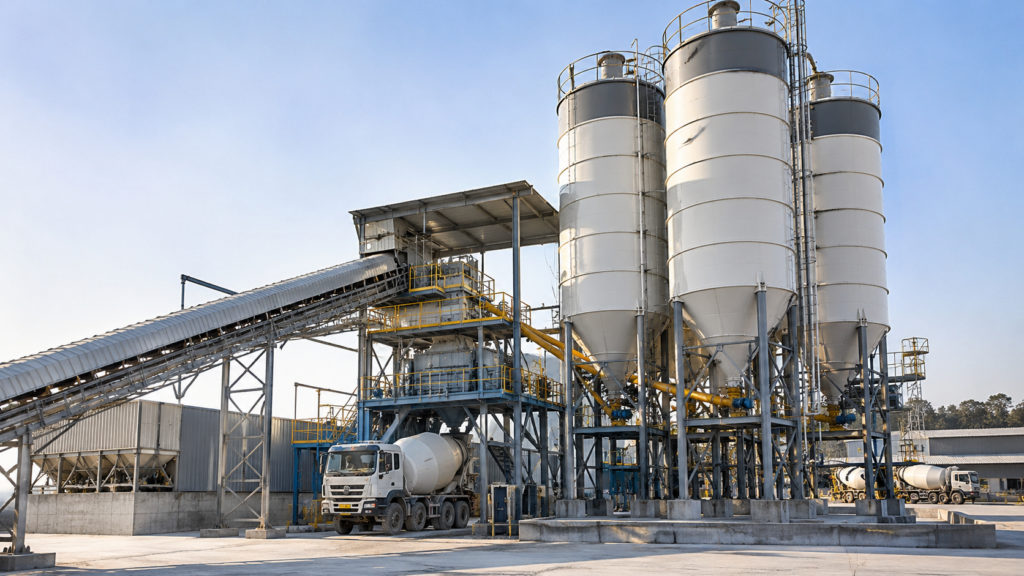
Cement storage silos are essential equipment in ready-mix concrete plants, batching plants, infrastructure projects and industrial construction facilities. They allow large quantities of cement to be stored and supplied to the production process when required.
However, one of the most frustrating operational problems is cement silo blockage. Material may stop flowing through the discharge outlet, form hard deposits inside the silo or discharge irregularly despite sufficient material remaining in storage.
These problems can interrupt batching operations, increase equipment maintenance requirements and create unexpected downtime.
Understanding the causes of cement flow problems is important for plant operators, maintenance engineers and businesses planning new cement storage installations.
In this guide, we explain why cement gets stuck inside silos, how common blockage mechanisms develop and what can be done to maintain reliable material flow.
What Is Cement Silo Blockage?
Cement silo blockage occurs when stored cement cannot move through the silo and discharge system at the required rate.
In a typical cement storage arrangement, dry cement is stored inside an enclosed vessel and discharged through a lower hopper or discharge system into downstream equipment, such as a screw conveyor.
When material flow becomes restricted, the production system may receive less cement than required or experience a complete interruption in discharge.
A cement silo may appear to contain sufficient material while the discharge system receives little or no cement.
Depending on the installation, this may result from material flow characteristics, moisture-related hardening, outlet restrictions, equipment faults or unsuitable discharge conditions.
Why Does Cement Get Stuck Inside a Silo?
Several factors can contribute to cement discharge problems. In many cases, more than one condition is responsible.
1. Moisture and Cement Caking
Moisture is a major concern during the storage and handling of cement.
Cement is a hydraulic material, meaning it reacts chemically with water. When moisture enters a storage silo, it may cause cement particles to form lumps or hardened deposits.
Potential sources of moisture include:
- Water entering through damaged seals or poorly maintained access points.
- Moisture entering through the pneumatic filling system.
- Condensation under certain operating and environmental conditions.
- Exposure during maintenance or improper material handling.
Once significant hardening occurs, affected material may no longer behave like free-flowing powder.
Prevention: Maintain the silo’s weather protection, inspect seals and ensure that filling air and related equipment meet the requirements of the storage system.
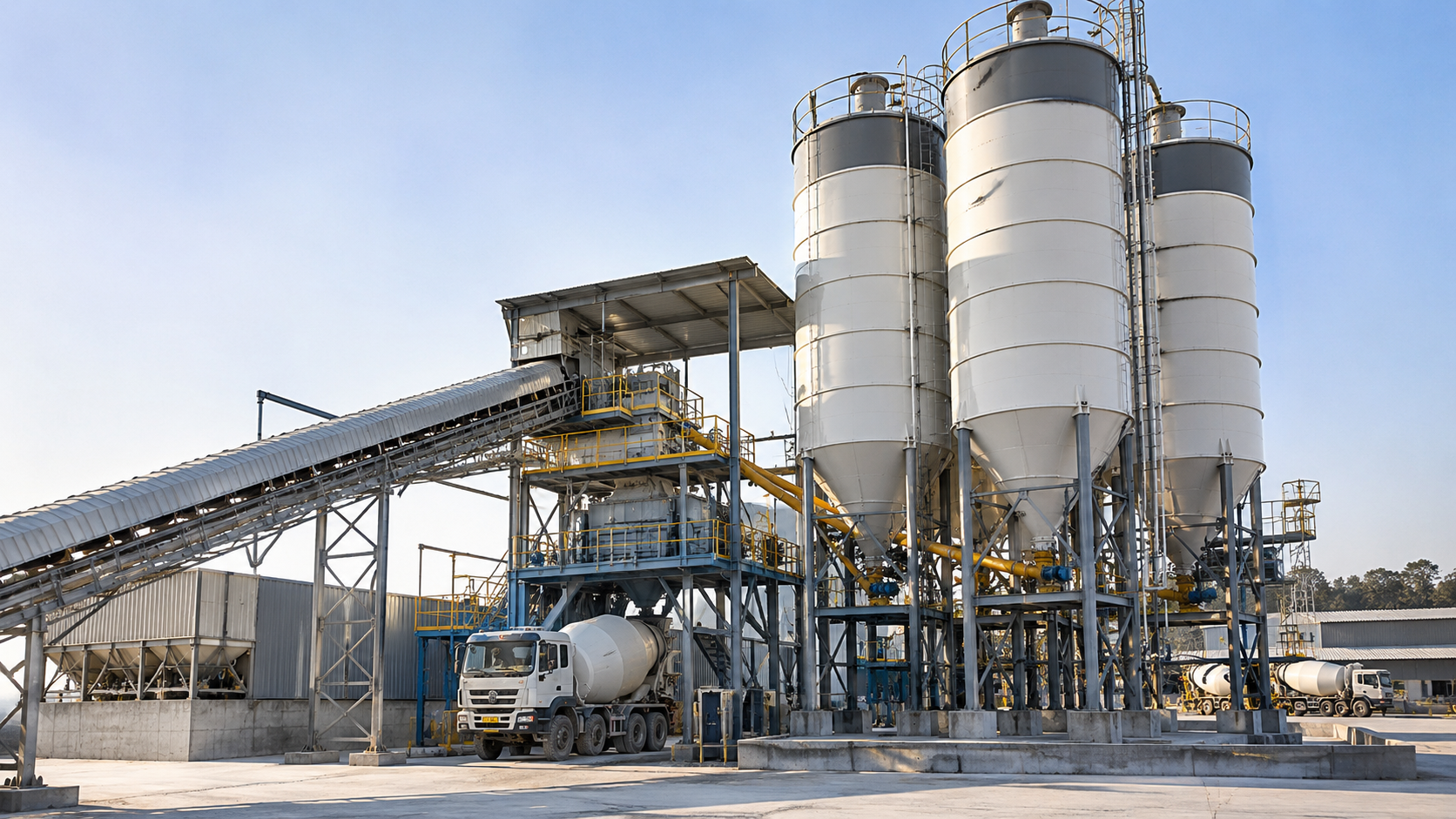
2. Bridging or Arching Above the Outlet
Bridging, also called arching, occurs when cohesive bulk material forms a stable structure across a discharge opening.
This arch supports the material above it and prevents normal discharge.
Even when the silo contains substantial material, cement may stop flowing into the connected equipment.
Bridging is influenced by factors such as:
- Material cohesive strength.
- Outlet geometry and dimensions.
- Consolidation during storage.
- Moisture and material condition.
- Hopper design and discharge arrangements.
Because bridging is a material-flow problem, the correct solution depends on understanding the stored material and the silo configuration.
3. Ratholing Inside the Silo
Ratholing is another important bulk material flow problem.
It occurs when a flow channel develops above the discharge opening while material outside that channel remains stationary.
In some cases, material continues to discharge through the central channel until the channel empties, even though considerable material remains elsewhere inside the silo.
This can reduce the usable storage capacity and create irregular material supply.
Ratholing may be associated with cohesive material, unsuitable hopper geometry and funnel-flow conditions.
Plant operators should not assume that every discharge problem is caused by a faulty screw conveyor. The stored material’s flow behaviour must also be considered.
4. Unsuitable Hopper and Outlet Design
The lower portion of a silo plays an important role in controlling material discharge.
Hopper wall angles, outlet dimensions, wall friction and material properties influence how bulk solids move toward the discharge point.
A design that works for one material may not provide the same performance when used with another powder.
For reliable operation, silo discharge geometry should be selected using appropriate material-flow information and engineering calculations.
Important: Increasing outlet size or modifying hopper geometry without a proper engineering assessment may create structural or operational risks.
5. Long Storage Periods and Material Consolidation
Bulk powders can change their flow behaviour during storage.
Under sustained pressure from the material above, particles may consolidate and develop increased resistance to flow.
Changes in temperature, moisture exposure and storage duration may further influence this behaviour.
These conditions can make stored material more difficult to discharge, particularly when the silo and downstream handling equipment are not designed for the relevant material properties.
6. Problems in the Discharge Equipment
Not every apparent silo blockage originates inside the storage vessel.
In some installations, the actual problem may be located in the discharge valve, feeder, screw conveyor or associated control equipment.
Possible causes include:
- Mechanical jamming in the screw conveyor.
- Damaged or incorrectly operating discharge valves.
- Electrical or drive faults.
- Material buildup around the discharge connection.
- Incorrectly configured flow assistance equipment.
A systematic investigation should distinguish between material-flow problems inside the silo and mechanical problems in the downstream equipment.
Bridging vs Ratholing: What Is the Difference?
Although these two terms are sometimes used interchangeably, they describe different flow problems.
| Factor | Bridging | Ratholing |
|---|---|---|
| Basic mechanism | Stable material arch forms above the outlet | Flow channel develops while surrounding material remains stationary |
| Typical symptom | Discharge stops | Material discharges irregularly or stops despite remaining inventory |
| Main concern | Outlet obstruction | Reduced usable capacity and stagnant material |
| Engineering consideration | Material strength and outlet geometry | Flow pattern, material properties and hopper design |
Both problems can affect production reliability and may require specialist material-flow assessment.
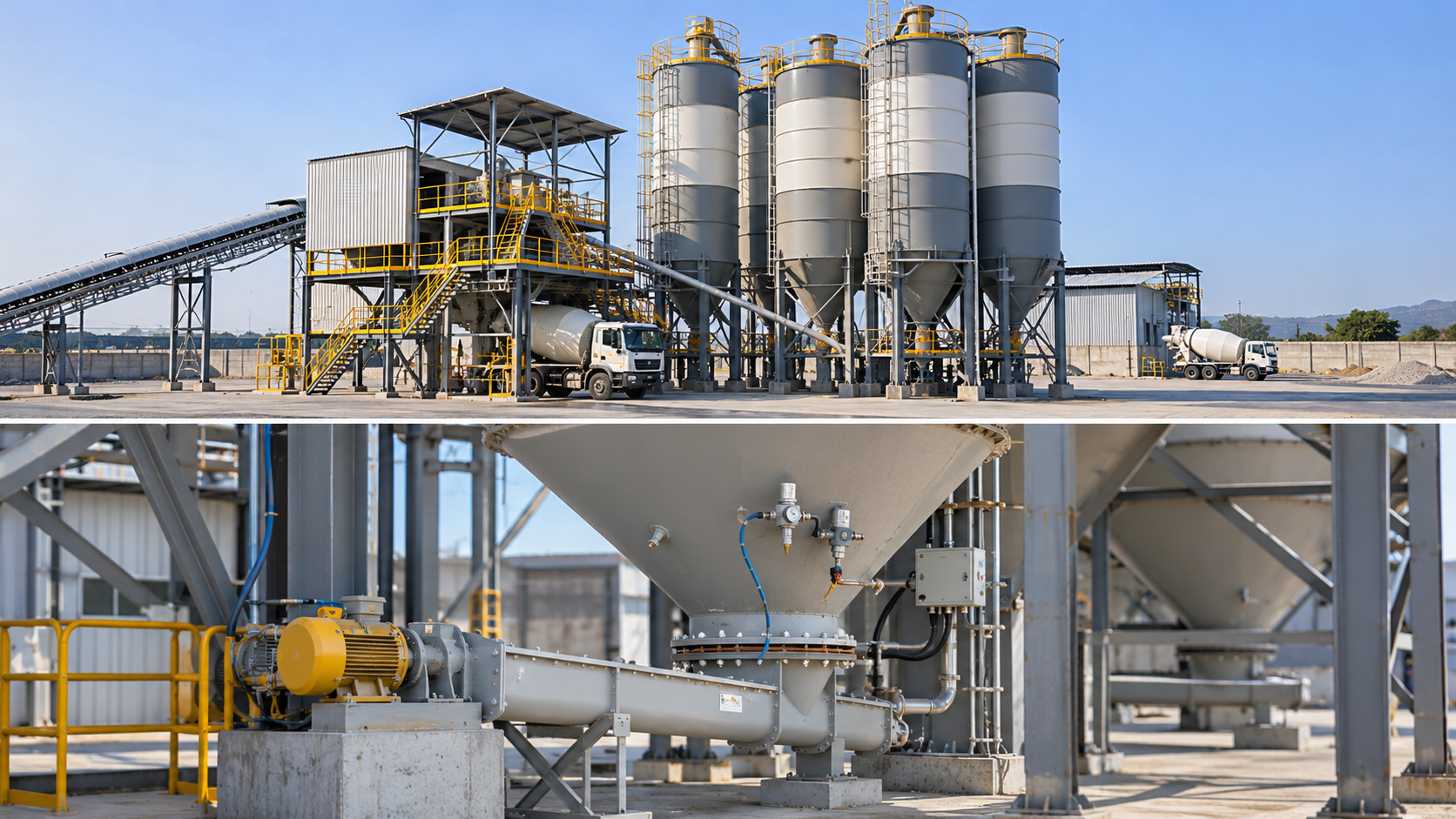
Understanding the Cement Silo Discharge System
The discharge arrangement generally includes a combination of storage, flow-control and material-transfer components.
Depending on the equipment design, these may include:
- Silo hopper or bottom discharge section.
- Discharge valve.
- Screw conveyor or other feeder.
- Approved aeration or flow-assistance equipment.
- Level monitoring and control devices.
- Associated piping and electrical controls.
Each component should be selected and maintained according to the specific application.
For businesses planning a new installation, understanding the complete system is just as important as choosing the storage capacity.
Explore Shrinathji Infracon’s guide on cement silo capacity calculation to learn more about storage requirements.
How to Prevent Cement Silo Blockage
Preventive measures should address material condition, equipment design and maintenance practices rather than relying on emergency blockage removal.
1. Protect Cement from Moisture
Inspect access covers, seals, filling connections and other potential entry points for water.
Review the condition of filling air systems and ensure they are suitable for handling dry cement.
Moisture protection is particularly important in environments exposed to seasonal rain and high humidity.
2. Maintain the Discharge System
Inspect discharge valves, screw conveyors, drive assemblies and associated controls according to the manufacturer’s recommendations.
Pay attention to unusual noise, excessive drive load, restricted discharge or repeated interruptions.
Do not operate damaged equipment until the problem has been safely assessed.
3. Use Properly Engineered Flow Assistance
Some silo systems use aeration devices or other flow-assistance technologies to support material discharge.
However, these devices must be correctly selected and configured for the material and storage system.
Excessive aeration, uncontrolled vibration or inappropriate flow assistance can introduce additional operational or structural problems.
Flow-assistance modifications should therefore be reviewed by a qualified engineer or equipment manufacturer.
4. Monitor Material Flow Performance
Plant operators should observe discharge behaviour and record recurring problems.
Useful information includes:
- Whether discharge stops suddenly or gradually.
- Whether flow changes after material deliveries.
- Whether the problem occurs following long storage periods.
- Any unusual discharge equipment behaviour.
- Differences between expected and observed material inventory.
These observations can help maintenance teams identify patterns and investigate likely causes.
5. Follow a Preventive Maintenance Schedule
A structured maintenance program helps identify deterioration before it causes serious operational interruptions.
Routine inspections should cover:
- Silo structure and visible corrosion.
- Filling connections and seals.
- Ventilation and filtration equipment.
- Level indicators and monitoring systems.
- Discharge valves and screw conveyors.
- Flow assistance and related controls.
- Visible signs of moisture or material leakage.
For a broader maintenance overview, read the Cement Silo Maintenance Guide by Shrinathji Infracon.
What Should You Do When a Cement Silo Is Blocked?
A blocked cement silo must be treated as a potentially hazardous equipment condition.
Operators should never attempt to clear a blockage by entering the silo, striking the shell, opening a potentially pressurised discharge connection or using improvised methods.
Stored bulk material can move unexpectedly, and a seemingly stable blockage may collapse without warning.
The appropriate response is to:
- Stop affected operations using approved plant procedures.
- Prevent further filling or discharge activity where required.
- Notify the responsible maintenance or engineering personnel.
- Apply the required isolation and lockout/tagout procedures.
- Assess pressure, stored material and downstream equipment hazards.
- Identify the probable cause through a documented inspection process.
- Use a qualified specialist and approved method for any necessary blockage removal.
- Verify equipment condition before authorising a restart.
Safety warning: Silo entry is a high-risk confined-space activity and must never be used as a routine blockage-clearing method. Any unavoidable entry requires a formal risk assessment, permits, isolation, atmospheric evaluation, rescue planning and compliance with applicable regulations.
How Poor Cement Flow Affects Batching Plant Productivity
In a ready-mix concrete plant, cement must reach the batching equipment in the required quantity and at the appropriate time.
Restricted discharge can interfere with this process.
Potential operational consequences include:
- Delays in preparing concrete batches.
- Interruptions to scheduled production.
- Additional maintenance and inspection labour.
- Increased equipment downtime.
- Reduced effective storage availability.
- Higher costs associated with correcting recurring faults.
For example, consider a batching plant that experiences repeated cement discharge interruptions during production.
Even if the silo contains enough material, the plant may be unable to maintain its planned production schedule until the discharge issue has been corrected.
Over time, repeated interruptions can become a significant operational concern.
Choosing a Cement Silo That Supports Reliable Material Flow
When selecting a cement silo, buyers often begin by comparing storage capacity, purchase cost and installation requirements.
These factors are important, but they should not be the only considerations.
The discharge arrangement, hopper geometry, construction quality, operating environment and downstream equipment compatibility also deserve attention.
Before purchasing a silo, discuss the following with the supplier:
- Required cement storage capacity.
- Expected daily cement consumption.
- Material characteristics and discharge requirements.
- Silo installation location and environmental exposure.
- Compatibility with the batching plant.
- Discharge valve and conveyor configuration.
- Maintenance access and operating safety.
- Available equipment documentation and support.
A properly specified system can reduce the likelihood of avoidable operational problems.
For additional guidance, read Things to Check Before Buying a Cement Silo.
Frequently Asked Questions About Cement Silo Blockage
Why is cement not coming out of my silo?
Possible causes include cement caking, bridging, ratholing, outlet obstruction, a defective discharge valve or a mechanical problem in the screw conveyor. The exact cause should be identified through an approved inspection process.
What causes cement to become hard inside a silo?
Moisture exposure can initiate cement hydration and cause lumps or hardened deposits to develop. Storage conditions and material consolidation may also contribute to poor powder flow, although consolidation does not necessarily mean that hydration has occurred.
Can cement silo aeration prevent blockages?
Properly designed aeration can assist the discharge of suitable fine powders. Its effectiveness depends on the material properties and equipment arrangement. Aeration should not be treated as a universal solution to every blockage problem.
What is the difference between bridging and ratholing?
Bridging occurs when material forms a stable arch across an outlet, while ratholing occurs when material flows through a channel and surrounding material remains stagnant.
How can cement silo blockage be avoided?
Preventive measures include moisture protection, appropriate silo and outlet design, correct discharge equipment selection, routine maintenance and the investigation of recurring flow problems.
Is it safe to enter a silo to remove hardened cement?
No. Entering a silo to clear material is extremely hazardous and must never be attempted without a fully engineered confined-space entry procedure and all required safety controls. Specialist non-entry methods should be evaluated first.
Conclusion
Cement silo blockage is more than a minor maintenance inconvenience. It can affect material availability, production continuity, equipment reliability and operational safety.
Understanding the differences between bridging, ratholing, moisture-related caking and mechanical discharge faults is the first step toward preventing repeated problems.
For plant operators and construction businesses, reliable cement storage depends on proper design, suitable material handling equipment, consistent inspections and safe maintenance practices.
Explore Cement Storage Solutions with Shrinathji Infracon
Shrinathji Infracon provides cement and fly ash storage silos along with industrial material handling and construction equipment solutions.
Whether you are planning a new batching plant, expanding cement storage capacity or evaluating a storage system for an infrastructure project, choosing appropriate equipment is important for long-term operational reliability.
Learn more about cement and fly ash storage silos or contact Shrinathji Infracon to discuss your project requirements.
 English
 Hindi
 Arabic
 Chinese (Simplified)
 Dutch
 French
 German
 Italian
 Portuguese
 Russian
 Spanish