


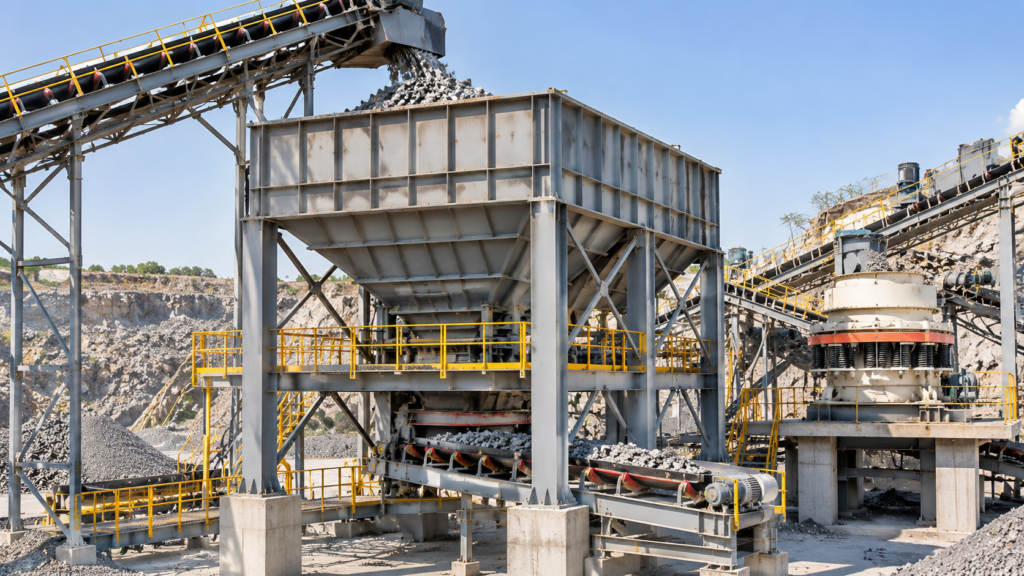
In a stone crushing plant, consistent material flow is essential for achieving stable production. Jaw crushers, cone crushers, vibrating screens and belt conveyors work together to process large rocks into aggregates of different sizes. However, material does not always move through the plant at a constant rate.
Variations in upstream supply, equipment capacity and operating conditions can create irregular feeding. This is where a surge hopper becomes an important part of a well-designed crusher plant.
A surge hopper temporarily stores bulk material and helps regulate its supply to downstream equipment. When properly designed and integrated with a controlled feeder, it can help reduce production interruptions, support stable crusher operation and improve material handling efficiency.
In this article, we explain what a surge hopper is, how it works, its main components, benefits, capacity considerations and the factors to evaluate before purchasing one.
What Is a Surge Hopper?
A surge hopper, sometimes called a surge bin or buffer hopper, is an industrial storage and material handling component used to temporarily hold bulk material between processing stages.
In crusher plants, surge hoppers are commonly positioned between equipment operating at different material flow rates, such as primary and secondary crushing circuits.
The hopper receives material from an upstream conveyor or processing machine, stores a limited working quantity and supplies material to the next stage through a suitable feeder.
Unlike a large storage silo designed for longer-term inventory, a surge hopper is generally intended to provide short-term buffering and improve process continuity.
Its size, geometry, discharge system and structural design depend on the material and operational requirements of the plant.
Why Is a Surge Hopper Important in a Crusher Plant?
A typical aggregate processing plant involves multiple interconnected machines. The output from one processing stage becomes the input for another.
However, these machines may not always operate at exactly the same production rate.
For example, the primary crusher may deliver material in changing quantities while the secondary crusher performs best with a relatively consistent feed.
Without sufficient buffering, changes in upstream supply can directly affect downstream operation.
A surge hopper helps absorb these temporary differences by allowing material inventory to increase or decrease within an appropriate operating range.
This can help reduce unnecessary interruptions and support smoother operation of connected equipment.
For a broader understanding of the equipment involved, read Shrinathji Infracon’s guide to crusher plant types, applications and best practices.
How Does a Surge Hopper Work?
The working principle of a surge hopper is straightforward, although actual system design requires careful engineering.
Step 1: Material Enters the Hopper
Crushed stone or other bulk material enters through the upper receiving opening, commonly from a belt conveyor.
The hopper provides temporary space for accumulating material when the incoming rate exceeds the outgoing rate.
Step 2: Material Is Temporarily Stored
The hopper holds a working quantity of material between its minimum and maximum operating levels.
The stored inventory provides a buffer against short-term variations in material supply.
Step 3: A Feeder Regulates Discharge
Material exits through the lower outlet into a suitable feeding arrangement, such as a belt feeder, vibrating feeder or apron feeder, depending on the application.
The feeder regulates the material delivery rate to the downstream machine.
Step 4: Downstream Equipment Receives Controlled Feed
The controlled feeder supplies the next crusher or processing stage according to its operating requirements.
Level sensors and automated control systems may be used to coordinate material inventory and feeder operation.
The objective is not necessarily to keep the hopper completely full, but to maintain a suitable operating range that allows the system to absorb variations in both incoming and outgoing material flow.
Main Components of an Industrial Surge Hopper
A surge hopper installation may consist of the following components:
- Receiving section: The upper opening through which bulk material enters the hopper.
- Hopper body: A fabricated steel structure designed to contain the material and withstand the applicable loads.
- Sloping discharge walls: Surfaces that direct material toward the outlet while supporting the intended flow pattern.
- Wear liners: Replaceable protective surfaces used where abrasion and impact may damage the hopper body.
- Discharge opening: The lower outlet through which material enters the feeder.
- Feeding equipment: A belt, vibrating or apron feeder that controls the material flow rate.
- Support structure: Steel framework and foundations designed to withstand operating, material and dynamic loads.
- Level monitoring: Instruments that measure material inventory or detect high and low levels where required.
Actual component specifications vary with hopper capacity, material properties, installation layout and the equipment connected to the system.
Benefits of Using a Surge Hopper in Crusher Plants
1. More Consistent Material Supply
One of the primary advantages of a surge hopper is its ability to buffer variations in material delivery.
Instead of passing every upstream fluctuation directly to the next crusher, the hopper can temporarily store or release material.
This supports more predictable downstream feeding when the storage and feeder system are correctly designed.
2. Reduced Risk of Feed Starvation
Feed starvation occurs when a processing machine receives less material than required for its intended operation.
A surge hopper with sufficient usable inventory can continue supplying a downstream crusher during certain short upstream interruptions.
However, the duration of this support depends on the available material inventory and the discharge rate.
3. Improved Cone Crusher Feeding Conditions
Many cone crusher applications benefit from a controlled and evenly distributed feed.
For suitable crushing chambers, maintaining recommended choke-fed conditions can support stable crusher performance.
A surge bin, feeder and level monitoring arrangement may help achieve these conditions.
The correct operating method must follow the particular crusher manufacturer’s recommendations.
4. Better Coordination Between Processing Stages
Crusher plants often contain equipment with different operating characteristics and throughput limits.
A surge hopper can reduce the direct effect of short-term upstream fluctuations on downstream machines.
This can make production coordination more manageable when combined with appropriate plant controls.
5. Potential Reduction in Unplanned Interruptions
When material-flow fluctuations are a major cause of stoppages, properly designed surge capacity may help improve operational continuity.
However, a surge hopper cannot compensate indefinitely for inadequate upstream production or serious equipment failures.
Its benefit depends on the overall capacity balance of the crushing circuit.
Surge Hopper vs Dump Hopper: What Is the Difference?
Although both are used for handling bulk material, their main functions are often different.
| Feature | Surge Hopper | Dump Hopper |
|---|---|---|
| Primary purpose | Temporary storage and controlled downstream feeding | Receiving bulk material from trucks, loaders or other equipment |
| Typical location | Between processing stages | At material receiving points |
| Material delivery | Commonly receives material from conveyors | Often receives intermittent bulk loads |
| Main design concern | Buffer capacity and reliable discharge | Impact loading, receiving capacity and discharge |
| Common application | Secondary or tertiary crushing circuits | Primary crusher feed arrangements |
These terms can overlap in some equipment descriptions, and certain receiving hoppers also provide surge capacity.
The correct equipment configuration should therefore be based on its intended function rather than the product name alone.
Where Are Surge Hoppers Used in Aggregate Processing?
Surge hoppers can be installed in different sections of a material processing facility.
Common applications include:
- Between primary and secondary crushing stages.
- Ahead of cone crushers requiring controlled material delivery.
- Between screening and re-crushing circuits.
- Before certain downstream feeding or material handling systems.
- At processing stages where short-term inventory buffering is needed.
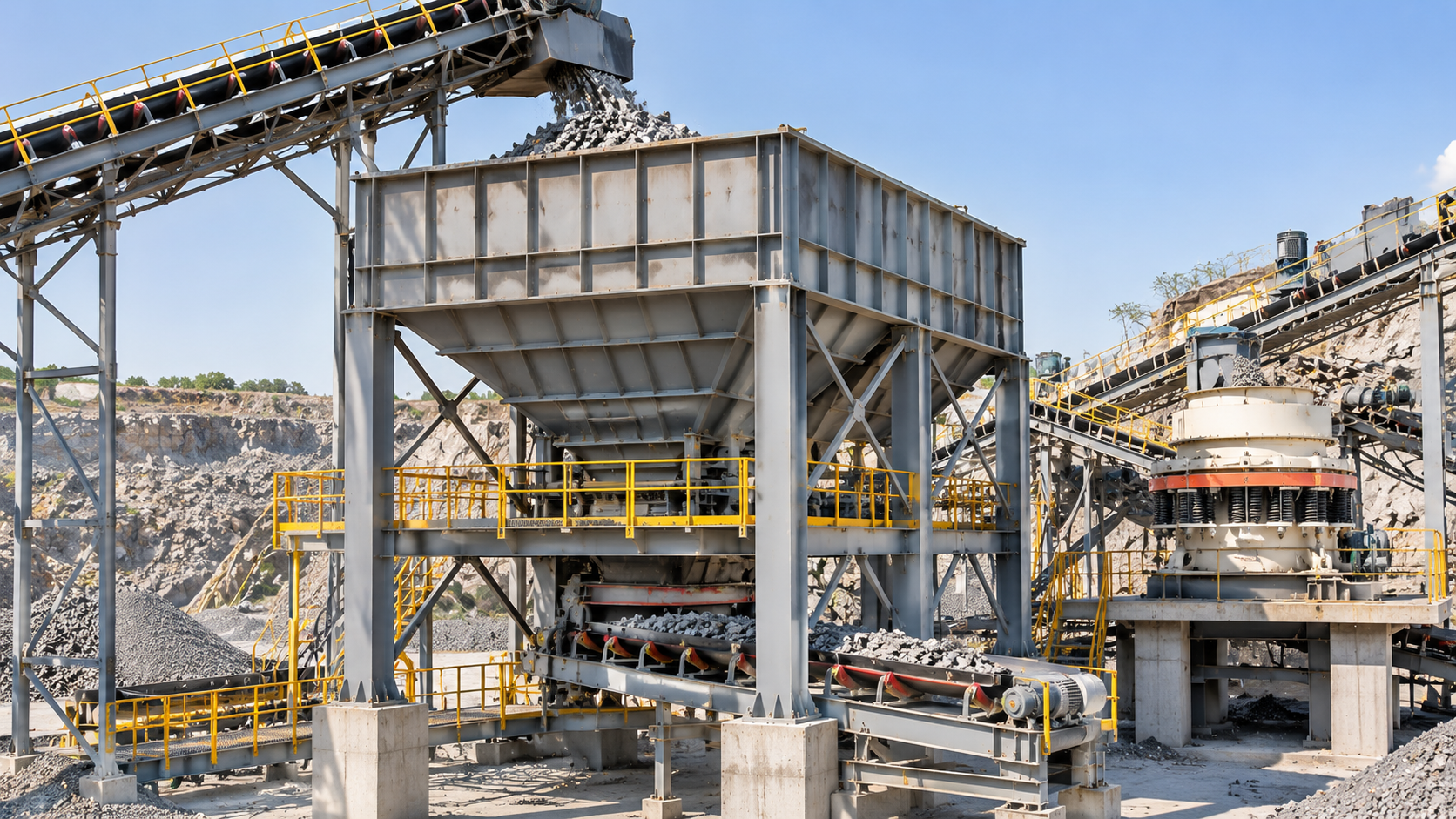
The ideal hopper location depends on plant layout, equipment capacity, material flow and the desired operating strategy.
How to Calculate Surge Hopper Capacity
Determining the appropriate surge hopper capacity is an important engineering task.
A preliminary estimate can be developed by considering the downstream material consumption rate and the amount of time the hopper must continue supplying material during a temporary upstream interruption.
Required usable buffer capacity (tonnes) = Downstream consumption rate (tonnes/hour) × Buffer duration (hours).
Example Calculation
Consider a secondary crusher that consumes 150 tonnes of material per hour.
Suppose the plant designer wants enough usable inventory to continue feeding the crusher for four minutes during a temporary upstream interruption.
Then:
Usable capacity = 150 × (4 ÷ 60) = 10 tonnes.
If the material has an assumed loose bulk density of 1.6 tonnes per cubic metre, the required usable material volume is:
10 ÷ 1.6 = 6.25 m³.
This means the working inventory required for the specified four-minute buffer is approximately 6.25 cubic metres under the stated assumptions.
However, the complete hopper’s geometric capacity will generally differ from its usable operating capacity.
The final design must consider:
- Minimum and maximum working inventory levels.
- Usable and non-usable material volume.
- Incoming and outgoing flow rates.
- Material bulk density and particle size distribution.
- Discharge and hopper geometry.
- Flowability, segregation and bridging risks.
- Impact, abrasion and structural loads.
- Control strategy and available installation space.
Engineering note: This simplified calculation is illustrative only. It is not a complete design method and should not be used to select or fabricate a hopper without engineering verification.
Important Factors When Selecting a Surge Hopper
1. Required Material Handling Capacity
The hopper should be sized according to the actual operating requirements of the processing circuit.
Both expected throughput and temporary variations in feed supply must be considered.
2. Type and Size of Material
Large, angular aggregates produce different impact, abrasion and flow conditions compared with smaller or more uniform materials.
Maximum lump size, fines content, moisture and bulk density are therefore important selection parameters.
3. Hopper Geometry and Discharge Design
Hopper wall slope, surface friction, outlet dimensions and feeder arrangement affect material movement.
Unsuitable geometry can contribute to material hang-ups, bridging or irregular discharge.
4. Structural Strength and Wear Resistance
Hoppers may be exposed to significant static loads, dynamic loading and material impact.
The supporting structure, connections, liners and foundations must be engineered for the applicable design conditions.
5. Integration with Existing Equipment
The hopper must be compatible with connected conveyors, feeders, crushers, instrumentation and maintenance access.
Mechanical compatibility alone is insufficient if the downstream equipment cannot handle the expected discharge rate.
6. Level Monitoring and Automation
Appropriate level instrumentation can support inventory control, feeder modulation and protection against overfilling or insufficient material supply.
Control strategies should be coordinated with the requirements of the crushing equipment and the full process circuit.
Common Surge Hopper Operating Problems
Like other bulk material handling equipment, surge hoppers can experience operational difficulties when improperly designed or maintained.
| Problem | Possible Cause | Recommended Response |
|---|---|---|
| Irregular discharge | Unsuitable outlet geometry or feeder performance | Review material flow and feeder operation |
| Material bridging | Material characteristics and discharge restrictions | Obtain a qualified flow assessment |
| Excessive liner wear | High impact or abrasive material | Inspect and review liner design |
| Hopper overfilling | Insufficient discharge or control failure | Inspect instrumentation and upstream interlocks |
| Frequent empty hopper | Insufficient upstream supply or inadequate buffer inventory | Review circuit capacity and control strategy |
These problems should be investigated systematically instead of repeatedly making temporary adjustments.
Surge Hopper Maintenance and Safety
A maintenance program should include inspection of the hopper structure, liners, outlets, feeders and associated electrical and control systems.
Maintenance teams should monitor:
- Wear and damage to hopper liners.
- Cracks, deformation or corrosion in structural components.
- Material buildup around discharge points.
- Feeder condition and abnormal vibration.
- Sensor accuracy and alarm operation.
- Guards, access points and support connections.
Important safety warning: Never enter a hopper or attempt to manually clear a blockage without approved isolation and confined-space safety procedures where applicable. Stored material can shift or collapse without warning. Any blockage-clearing activity should be planned and performed by qualified personnel using approved methods.
Frequently Asked Questions
What is the primary function of a surge hopper?
The primary function is to temporarily store bulk material and help regulate the supply between different stages of an industrial processing system.
Is a surge hopper necessary for every crusher plant?
No. The requirement depends on plant layout, feed variability, equipment selection and operating objectives. Not every crusher circuit needs a dedicated surge hopper.
What is the difference between a surge hopper and a silo?
A surge hopper primarily provides short-term buffering between processing stages, while a storage silo is generally intended to hold larger inventories for longer periods. Actual equipment applications can overlap.
How is surge hopper capacity calculated?
Preliminary usable capacity can be estimated using downstream consumption rate and required buffer duration. Final sizing requires additional material-flow, structural and process engineering calculations.
Can a surge hopper improve cone crusher efficiency?
A correctly designed surge hopper and feeder arrangement can help maintain stable, well-distributed feed conditions. The operating benefits depend on the crusher model, crushing chamber and process configuration.
Which feeder is used with a surge hopper?
Common choices include belt feeders, vibrating feeders and apron feeders. Selection depends on lump size, material properties, required capacity, impact conditions and the intended operation.
Conclusion
A surge hopper plays an important role in many crushing and screening plants by providing temporary material storage and helping manage changes in feed supply.
Its benefits can include more consistent downstream feeding, improved coordination between processing stages and reduced sensitivity to short-term upstream interruptions.
However, these advantages depend on appropriate hopper sizing, flow design, feeder selection, structural engineering and equipment controls.
For plant owners and industrial buyers, selecting a properly engineered surge hopper is an important part of planning a reliable aggregate processing system.
Explore Surge Hoppers and Crusher Plant Solutions with Shrinathji Infracon
Shrinathji Infracon supplies stone crusher equipment and manufactures industrial equipment including surge hoppers, dump hoppers, conveyor systems and storage silos.
Whether you are developing a new crusher plant or assessing material handling requirements for an existing facility, appropriate equipment selection can support long-term operational performance.
Explore the industrial equipment and crusher plant product range, or contact Shrinathji Infracon to discuss your project requirements.
 English
 Hindi
 Arabic
 Chinese (Simplified)
 Dutch
 French
 German
 Italian
 Portuguese
 Russian
 Spanish