


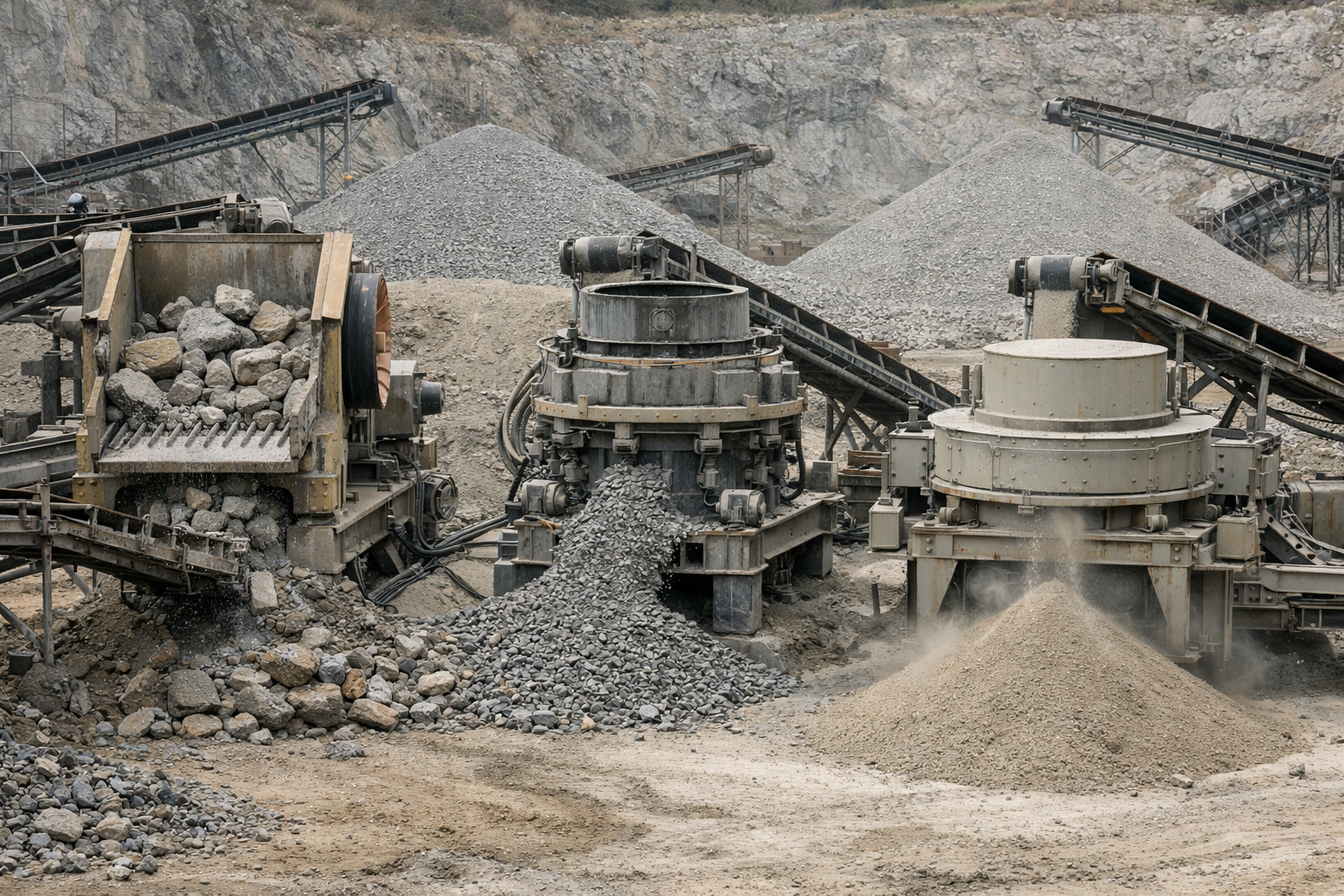
If you walk through enough crusher plants, you start noticing a pattern.
Most performance issues do not come from poor stone quality or manpower. They come from the wrong crusher being used at the wrong stage.
On paper, jaw crushers, cone crushers, and VSI crushers all look capable. In real operation, they behave very differently. Selecting one without understanding its role usually leads to higher wear, unstable output, and constant adjustments on site.
This article is written from an operational point of view, not a catalogue description.
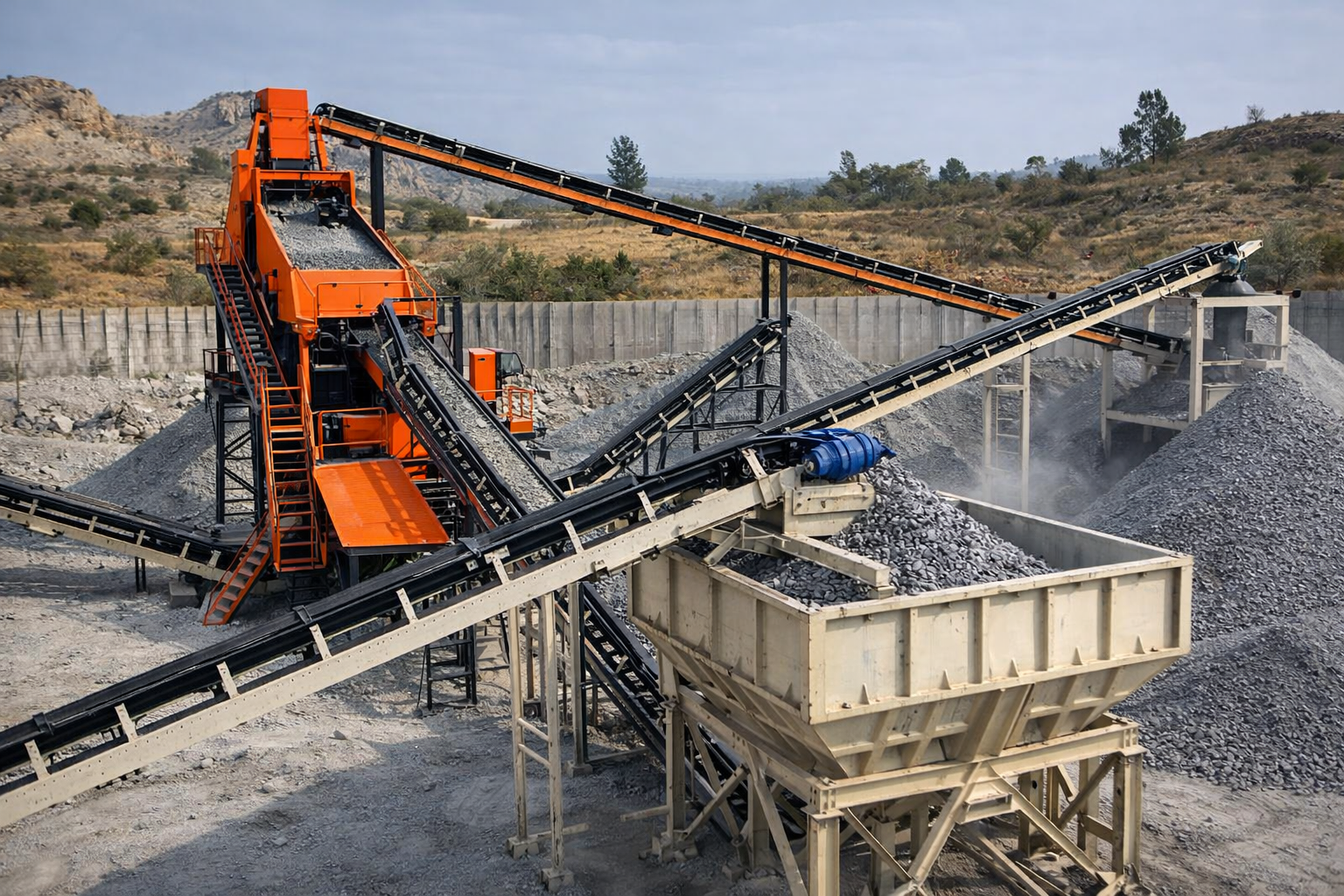
Start With One Basic Question
Before talking about machines, ask this:
Are you trying to break stone, control size, or improve shape?
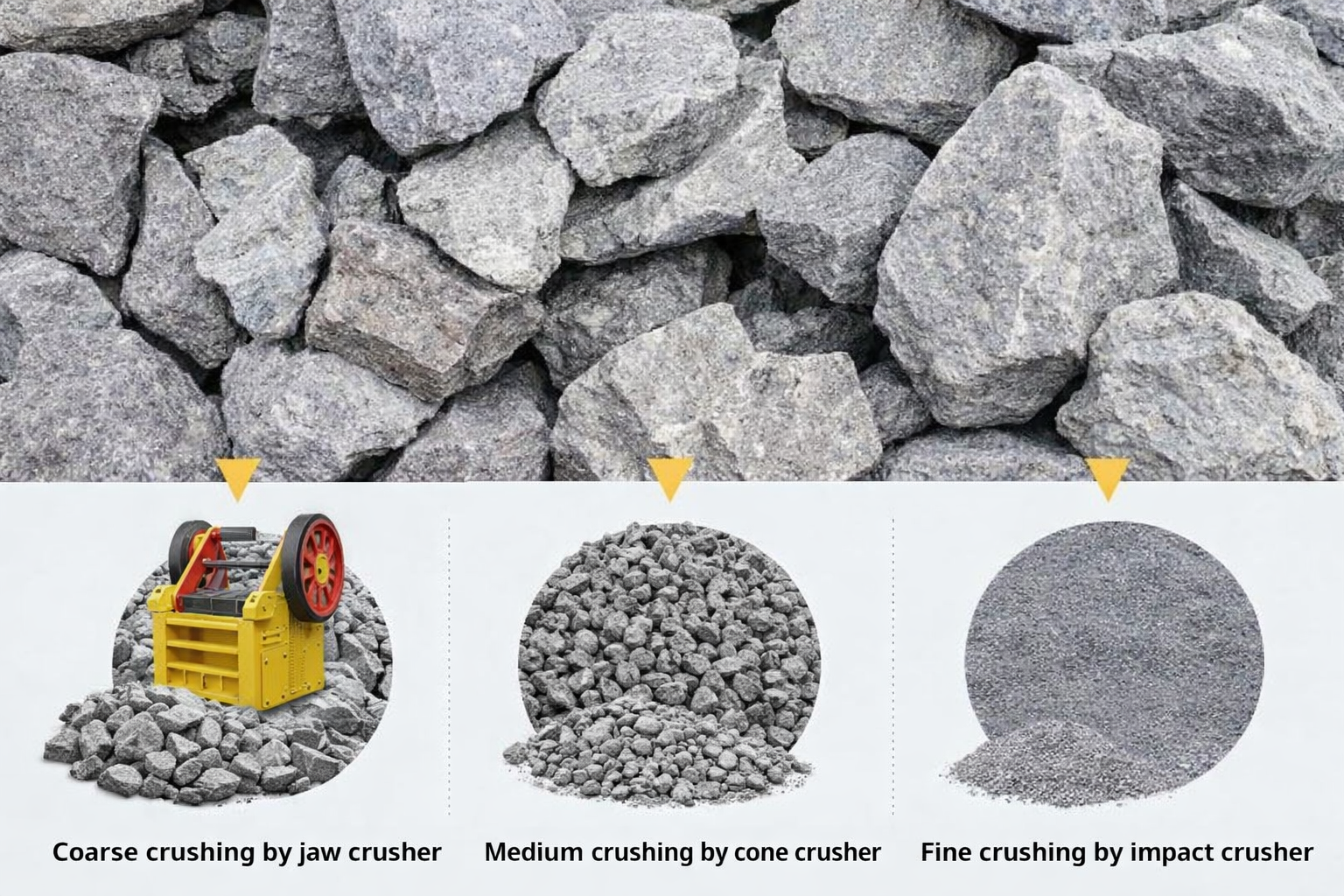
Each crusher answers only one of these properly.
Jaw Crusher: Chosen for Strength, Not Finish
Jaw crushers exist for one reason.
They can take large, rough, uneven stone and break it without complaint.
They work through compression. The stone is squeezed between a fixed jaw and a moving jaw. Nothing fancy, nothing delicate.
Where Jaw Crushers Make Sense
- First stage crushing
- Hard rock like granite, basalt, quartz
- Mining and large quarry operations
What Operators Like About Them
- They accept large feed sizes without choking
- They are mechanically simple
- They keep running even in rough conditions
What They Are Not Good At
- Producing clean shaped aggregates
- Delivering uniform size
- Final product preparation
On site, no one expects a jaw crusher to produce sale-ready material. Its job is to break, not to finish.
Cone Crusher: Where Control Begins
Once the jaw crusher has done its work, cone crushers take over.
A cone crusher does not smash stone. It controls it.
Material is compressed between a rotating mantle and a concave liner. This gives far better control over size and consistency compared to a jaw crusher.
Where Cone Crushers Are Used
- Secondary and tertiary stages
- Hard and medium hard material
- Road base and concrete aggregates
Why Plants Rely on Them
- Output size can be adjusted
- Product quality is more consistent
- Reduction ratio is higher than jaws
Practical Limitations
- Feed size must be controlled
- Setup and liner selection matter
- Not forgiving if operated incorrectly
Most problems blamed on cone crushers actually come from poor feeding or wrong configuration, not the machine itself.
VSI Crusher: Used When Shape Matters
VSI crushers are often misunderstood.
They are not meant to break big stone.
They are meant to shape material.
Instead of compression, they use impact. Stone is accelerated and thrown against anvils or a rock bed. The stone breaks along natural fracture points.
Where VSI Crushers Are Used
- Manufactured sand
- Final shaping stage
- Improving cubical shape
Why Contractors Use Them
- Sand quality improves
- Concrete finish improves
- Aggregate shape meets specification
Where They Cause Trouble
- If feed size is inconsistent
- If used as a primary crusher
- If wear parts are ignored
In simple terms, a VSI is a finishing machine. Using it too early in the process is an expensive mistake.
A Simple Way to Compare Them
| Purpose | Jaw | Cone | VSI |
| Break large stone | Yes | No | No |
| Control size | Limited | Yes | Limited |
| Improve shape | No | Moderate | Yes |
| Sand production | No | No | Yes |
This table is closer to real-world decision making than most brochures.
How Experienced Plant Owners Decide
People who have run plants for years do not ask which crusher is best.
They ask:
- What stage am I at
- What size do I need next
- What quality does the end user expect
- How stable is my feed
Most successful plants follow a familiar pattern.
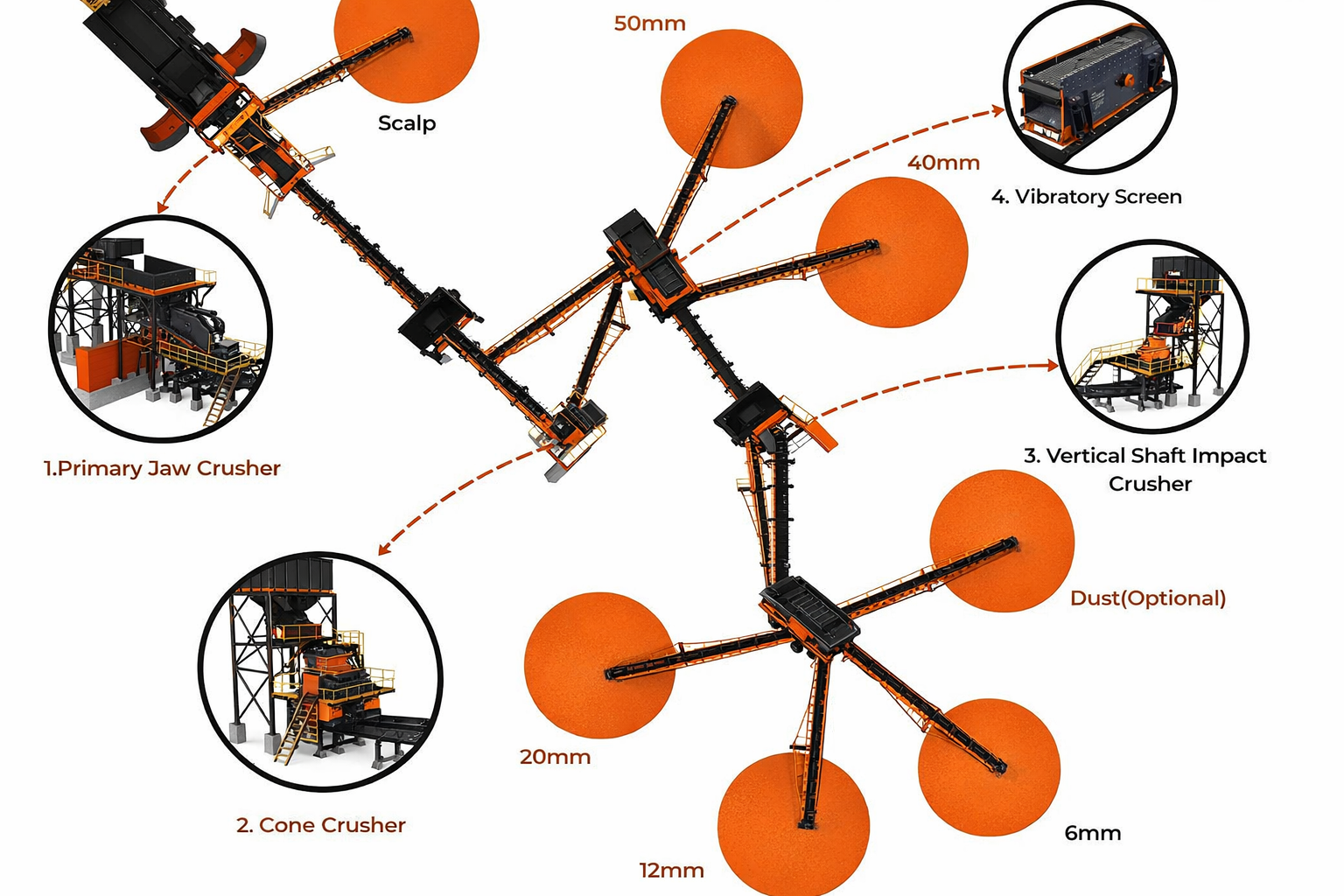
Jaw crusher first
Cone crusher next
VSI at the end
Trying to skip a stage usually increases wear and reduces output consistency.
Why Many Plants Use All Three
It is not about buying more machines.
It is about reducing stress on each machine.
When each crusher does only the job it was designed for:
- Wear reduces
- Output stabilizes
- Adjustments reduce
- Overall cost drops
Plants that ignore this usually spend more time stopping and adjusting than producing.
Final Thoughts
There is no universal crusher that fits every job.
Jaw crushers break stone.
Cone crushers control it.
VSI crushers shape it.
Once this is understood, equipment selection becomes much easier and far less expensive in the long run.
If you are planning a new plant or modifying an existing one, making the right crusher decision early saves years of operational frustration.
 English
 Hindi
Hindi Arabic
 Chinese (Simplified)
 Dutch
Dutch French
 German
 Italian
 Portuguese
 Russian
 Spanish